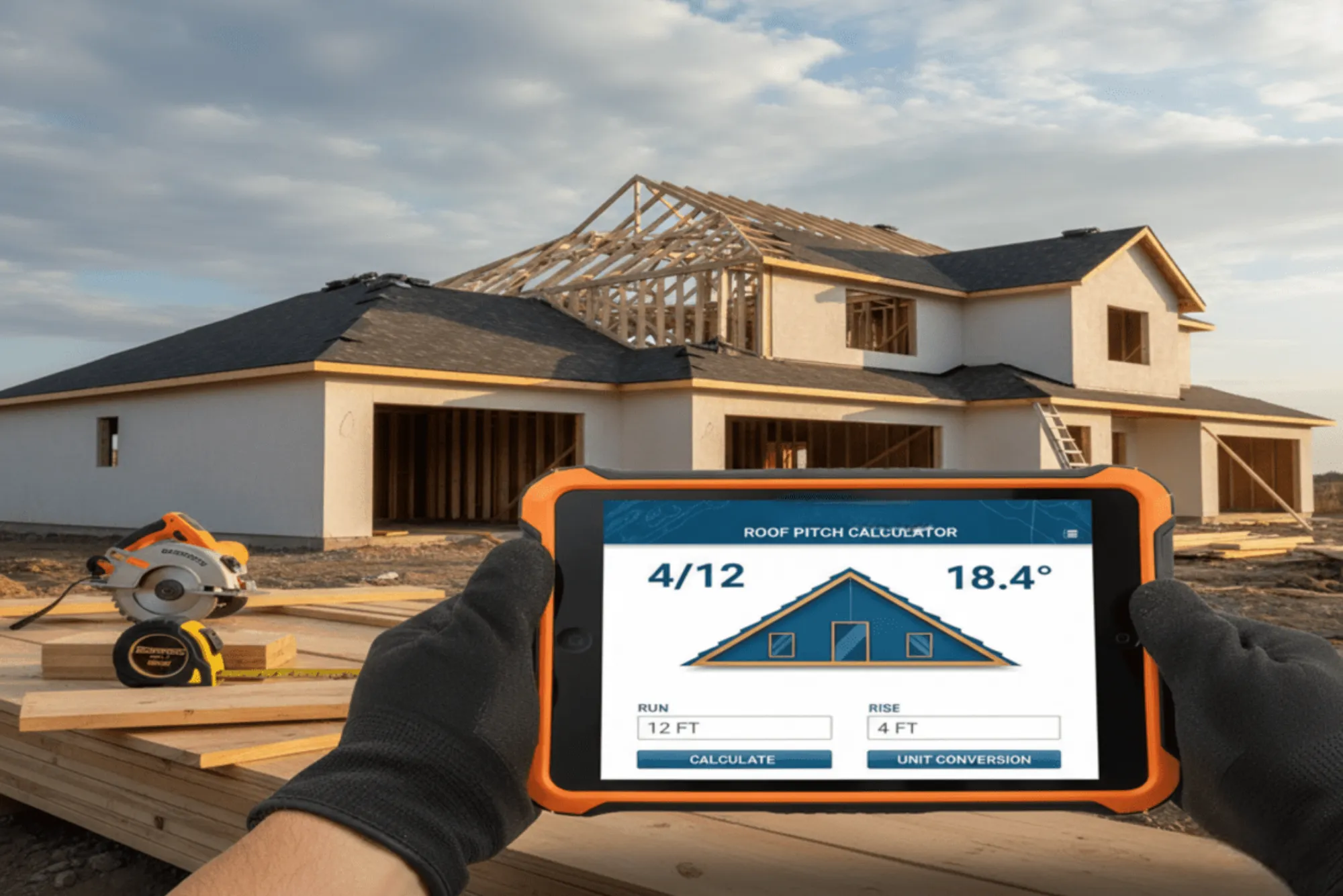
When you’re planning a roof — whether for a home in Bahawalpur, Multan or any part of South Punjab — knowing the precise pitch or slope is vital. Roof pitch determines material needs, drainage efficiency, structural load and overall durability. That’s why having a reliable, budget‑friendly tool like a roof slope and pitch calculator can save time, money, and avoid costly mistakes. In this post, we’ll explore the best budget roof pitch calculators and explain how to use them correctly for roofs in Pakistan’s climate and building context.
What Is a Roof Pitch & Why It Matters
Quick Answer: Roof pitch (or roof slope) is the ratio between the vertical rise and the horizontal run of a roof — and it affects drainage, structural integrity, and roofing material suitability.
Roof pitch is typically described as “rise over run” — for example, a 4:12 pitch means the roof rises 4 inches for every 12 inches of horizontal run. (aqviz.com)
Pitch influences how well rainwater drains, whether water pools, and whether the roof can safely support loads. (fielders.com.au)
For residential roofs, a common effective pitch range is between 4:12 and 6:12 — offering a balance of safe drainage and manageable construction. (aqviz.com)
For builders, architects, or homeowners in Punjab, using a proper roof pitch ensures longevity, reduces maintenance, and meets safety and weather resilience needs.
How to Calculate Roof Pitch Manually vs. Using a Calculator
Quick Answer: You can calculate roof pitch manually with rise/run ratio and basic trig, but calculators speed up the process, reduce human error, and provide multiple formats (ratio, degrees, percent).
Manual Method
Measure the vertical rise — the height from roof base to peak.
Measure the horizontal run — the horizontal span (e.g., 12 inches or 1 meter).
Compute:
Pitch Ratio (e.g., 6:12)
Pitch in Degrees using arctan(rise/run)
Slope percentage as (rise ÷ run) × 100 (skilledhub.com)
Why Calculators Are Better
They instantly convert rise/run into ratio, degrees, percent, and sometimes even total rafter length or material multipliers. (toolsrail.com)
Help avoid manual measurement or calculation errors — particularly useful if you’re not a structural engineer.
Useful when calculating for complex roofs or multiple spans.
Because of these advantages, I strongly recommend using online calculators for accurate and efficient roof design planning.
Best Budget Roof Pitch Calculators (Free & Easy to Use)
Quick Answer: Several online tools offer free, reliable roof pitch calculations. Best ones combine ease‑of‑use with multiple output formats.
Here are top free options:
NeedCalculator’s roof tool — a simple, intuitive interface that calculates pitch ratio, degrees, and slope percentage from rise and run. (Use the “roof slope and pitch calculator” on their site.)
Online Roof Pitch Calculator tools (offered by various platforms) — many support both metric and imperial units, making them suitable for Pakistani users. (intelcalculator.com)
Roof pitch charts + manual calculator combos — if you prefer offline planning, a static pitch chart (common 1/12 to 12/12 ratios) along with a basic calculator still works well. (aerialestimation.com)
Example Use Case (South Punjab Home):
Suppose a builder measures a rise of 150 mm over a run of 3000 mm. Plugging into a roof pitch calculator gives a ratio of 6:12 (or equivalent metric ratio), an angle in degrees, and a slope percentage — helping decide whether standard roofing materials suffice or extra waterproofing is needed.
You can always rely on a calculator first, then double-check with manual measurements once roof framing starts.
“I always check slope and grade with an online calculator — also has run/rise conversions if you switch measurement systems.” — a working‑class roofer on Reddit (reddit.com)
Understanding Roof Slope Ranges & Suitable Use Cases
Quick Answer: Roof slopes span from nearly flat to very steep. Choose slope based on roofing material, rainfall exposure, maintenance needs, and building design.
| Pitch Range / Classification | Typical Use / Suitability | Comments |
|---|---|---|
| Low Slope (2:12 – 4:12) | Flat roofs, modern architectural style, commercial buildings | Requires special waterproofing; careful drainage design needed. (skilledhub.com) |
| Standard / Medium (4:12 – 9:12) | Most residential homes, bungalows, suburban builds | Best balance of drainage, material options, cost. (fixr.com) |
| Steep Slope (9:12 and above) | Traditional homes, high‑rainfall regions, heavy runoff | Better drainage and snow/rain shedding; higher structural & safety requirements. (aerialestimation.com) |
Why this matters for Punjab:
South Punjab does not face heavy snow, but during monsoon or seasonal rains — adequate slope ensures efficient runoff and reduces leak risk. For cost‑conscious builds, a medium slope (e.g. 5:12 or 6:12) is often ideal. If you use calculators early, you can adjust your design accordingly before ordering materials.
How Roof Pitch Calculation Fits Local Construction Context
Quick Answer: In Punjab, accurate slope calculations align with modern training programs and professionalization of the construction industry.
Under the Punjab Skills Development Fund (PSDF) and provincial technical‑vocational training schemes, construction‑sector training includes roofing, masonry, and structural courses aimed at modern building methods. (pakistantoday.com.pk)
One of the 24 new construction labs established includes operations in Bahawalpur — local trainees learn modern roof framing and slope calculation techniques under these government‑backed efforts. (pakistantoday.com.pk)
Using a free online calculator ensures that even small contractors or newly trained masons can apply accurate, modern standards without expensive equipment — advancing the professionalism of South Punjab’s housing construction.
Thus, integrating roof pitch calculators into local building workflows supports both quality and compliance with structural standards.
How to Use a Budget Roof Pitch Calculator: Step‑by‑Step
Quick Answer: Collect accurate measurements, choose correct unit system, plug into calculator, interpret results (ratio, degree, slope), then adjust roof design accordingly.
Steps:
Measure the vertical rise (from eave/base to peak) and horizontal run (base span). Use a level, tape, or measuring rod.
Open a free online tool (like the tool on NeedCalculator). Enter rise and run; select units (mm, cm, inches, etc.).
Read outputs: pitch ratio (e.g. 6:12), slope in degrees, slope as percentage, and — if provided — roof surface multiplier or required rafter length.
Choose appropriate roofing material based on pitch: flat membranes for low slopes, shingles/tiles for medium slopes, heavy‑duty materials for steep slopes.
Cross‑check with local building codes or construction standards (especially for waterproofing and load bearing).
Pro Tip: If you’re working in metric (common in Pakistan), convert run to meters or cm before calculation — many calculators support metric inputs.
Where to Get Reliable Free Roof Pitch Tools — and Why
Quick Answer: Use reputable online platforms offering calculator tools; they’re free, unit‑flexible, and instantly output multiple useful formats (ratio, degrees, percent).
One such site offers a free roof slope and pitch calculator that’s simple, fast and trustworthy. Use it to:
Estimate roof materials and costs early in project planning
Verify contractor or mason calculations for accuracy
Compare different roof designs (flat vs slope vs steep) quickly
These tools democratise access to precise structural calculations — especially useful for small contractors, local builders, or homeowners doing DIY in regions like South Punjab.
By using such a tool you practically empower yourself with professional‑grade planning, often expected only from larger firms.
Mid‑Project Mention: Regional & International Workforce Movement
Many families from South Punjab — including skilled youth trained under provincial programs — now travel to the Gulf region for employment. For instance, a large fraction of CNAs, masons, and carpenters go to the UAE for construction work. As such, using standardised tools (like roof calculators) ensures their work meets international standards, boosting their credibility abroad and at home.
Bonus — When to Prefer Manual Calculation Over Online Tools
Quick Answer: When internet access is limited — for example on rural building sites — manual methods with a spirit level, tape measure and a simple formula still work.
Manual calculation is valuable when:
Working remotely or offline
Doing a quick sanity‑check on measurements
You need a rough estimate fast before ordering materials
Still — for precision, cross‑checking with a calculator afterward is best practice.
Frequently Asked Questions (FAQs)
Q1: What is the minimum roof pitch recommended for typical houses in Punjab?
A: For standard residential homes, a pitch between 4:12 and 6:12 is commonly recommended. This slope balances proper rainwater drainage with structural practicality.
Q2: Can I use metric measurements (mm or cm) with free roof pitch calculators?
A: Yes — many online calculators support metric input (mm, cm, m) in addition to imperial. Just enter rise and run in your preferred unit and read outputs.
Q3: What happens if I choose too low a slope for a roof in a rainy region?
A: Low‑slope roofs (e.g. 2:12) may suffer from poor drainage, water pooling, leaks, and require special waterproofing or membrane roofing rather than standard shingles.
Q4: Is using a free online roof pitch calculator reliable for professional construction?
A: Yes — when you input accurate measurements, these calculators produce reliable pitch ratio, angle and slope percentage. Always cross‑check with manual measurements and local building standards.
Q5: How does roof pitch affect material and cost estimates?
A: Roof pitch impacts the slope factor — steeper roofs need more material (longer rafters, larger surface area) and may require stronger framing, increasing cost. Pitch calculators often output a multiplier to help with these estimates.
Q6: Can small contractors in South Punjab benefit from using pitch calculators?
A: Absolutely — for small builders or contractors trained under local programs (e.g., through PSDF‑backed training), these tools help standardize roof design and improve build quality.
Q7: What is the most accurate way to confirm roof pitch on an existing house?
A: Use a level and tape measure to measure rise/run manually, then plug values into a reliable calculator. For more complex roofs, check framing plans or consult a structural professional.
Final Thought
As a builder and resident of South Punjab, I’ve seen many homes — from Bahawalpur city houses to rural brick‑and‑mortar cottages — suffer from poor drainage simply because roof slope was guessed rather than calculated. Tools like the roof slope and pitch calculator give everyone — from DIY homeowners to local masons — a simple, reliable way to bring professionalism into roof design.
For those in the region doing new projects, starting with a calculator ensures you buy the right amount of material, avoid water‑leak issues, and maintain structural integrity. If you also need to plan entire construction or roofing projects more comprehensively, you might want to consult a top‑rated IT company from South Punjab for CAD layouts — they can integrate roof geometry with structural plans seamlessly.